Estimating
Why, What, How?
There is a belief that Project Managers of business solution
and IT projects are not very good at estimating, unlike their
counterparts in construction projects. There is an error in this
belief - according to several construction Project Managers, they
are not particularly accurate either.
There are many theories and approaches
but no fully reliable way for predicting the time and effort it
will take to deliver a business solution. When you bear in mind
the complexity of any business solution
and the dramatic variance in individual productivity, you can
understand why it cannot be an exact science. Some IT developers
seem to be able to create systems as fluently as they speak their
mother tongue. Others, maybe sitting at the next desk, struggle
to deliver. There can be a factor of 10 to 1 in personal
productivity between the best and the worst. These are just a few
of many factors. We will take a look at several key issues then
summarise the drivers of effort.
There are many methods for estimating. If your organisation
has adopted standard practices you should probably stick to them
- but apply a little of your own understanding to the results.
Many approaches are geared to the delivery of a working IT system.
Fewer approaches have been formulated to estimate the overall
demands of delivering a successful business solution - ie
- the IT system, plus
- the process changes and detailed procedures, plus
- the capability and motivation of the workforce to use it.
Estimating techniques always involve assumptions and guesses.
We can, of course, just guess the result. Somehow, though, it
seems more scientific to guess the input data then perform some
impressive process to generate a mathematical result.
What we keep returning to is the value of past experience.
Experienced Project Managers will be able to estimate time and
effort on the basis of past experience - both their own and the
corporate experience of their colleagues. Some of the more
reliable forms of estimation are where this knowledge has been
captured and structured so that it can be share and re-used by
any Project Manager. To do this successfully you need a way of
capturing the factors that affect the effort
- we will return to those after examining some concepts and
techniques.
In the ePMbook, we will not study any specific techniques in
detail - you should go to the appropriate sources if you wish to
know more. Here are a few of the concepts that are used:
Approach
|
Commentary
|
| We did it before |
 Undoubtedly the most reliable information - provided you
have previously undertaken a similar project. Estimates
are based on the actual results from a similar previous
project. (Make sure you use the actual results and not
the original plan.) In some situations it is common to
repeat projects, eg roll-out programmes, or working for
software vendors who routinely implement the solution for
their clients.
Undoubtedly the most reliable information - provided you
have previously undertaken a similar project. Estimates
are based on the actual results from a similar previous
project. (Make sure you use the actual results and not
the original plan.) In some situations it is common to
repeat projects, eg roll-out programmes, or working for
software vendors who routinely implement the solution for
their clients. |
| Guess (estimation by analogy) |
Well, an educated guess based on past
experience of the Project Manager, and, hopefully, also
based on the collective experience and knowledge of
several Project Managers drawn from the results of may
specific projects. Here you are looking for analogous
experiences from which you can make direct estimates, or
from which you can extrapolate an estimate bearing in
mind what specific differences there are in your proposed
project. |
| Structured knowledgebase of past
experience |
This uses the concept of estimation by
analogy but builds a structured knowledgebase that is
used to accumulate experience from many projects and
Project Managers. The key to its success is an
intelligent way of classifying and quantifying the many variables that affect the time and effort.
|
| How many lines of code |
This is an IT Project Manager's view of
the world. Depending on the programming techniques and
languages to be used, you can use average productivity
rates to calculate how much effort will be required.
There are two significant flaws in this approach:
- How did you estimate the number of lines of code
that is the input to the calculation?
- Delivering a business solution is a much wider
challenge than creating a working computer system.
It is not valid to extrapolate the other work
from the IT development effort. Some systems are
easy to build but relatively hard to implement (particularly,
for example, package or component-based solutions)
and some solutions are complex in development
terms but not difficult to introduce into the
business. Beware of statements like "testing
effort should be 25% of development".
Take a look at Putman's SLIM (Software Lifecycle
Management) for an example of this logic.
|
| How much functionality |
Again, more of an IT perspective, but,
this time, giving a more scientific way of identifying
the input criteria - ie, how much functionality needs to
be delivered. Functionality can be identified from the
scope and initial high-level design of the solution. It
can be classified and quantified so that tables based on
past experience can be used to convert a given set of
functionality into realistic estimates. Take a look at
Albrecht's Function Point Analysis method to see this at
work.
|
| Top Down |
 A subsidiary technique. Once you have
established a good overall estimate for the project, you
sub-divide it down through the layers of the work
breakdown structure, for example, development will be 50%
of the total, testing will be 25% etc; then sub-divide
development and testing into their components etc etc etc. A subsidiary technique. Once you have
established a good overall estimate for the project, you
sub-divide it down through the layers of the work
breakdown structure, for example, development will be 50%
of the total, testing will be 25% etc; then sub-divide
development and testing into their components etc etc etc. |
| Bottom Up |
Each individual piece of work is
estimated on its own merit. These are then summed
together to find the estimated efforts for the various
summary level activities and overall project. One
disadvantage with this approach is the tendency for
overall effort to grow in line with the amount of detail
put into the plan. |
| Top-down meets bottom-up |
An overall estimate is calculated for
the project. Individual estimates are then calculated, or
drawn from previous plans, to represent the relative
weights of the tasks. The overall estimate is then
apportioned across the various summary and detailed level
tasks using the bottom-up figures as weights. |
The effort to develop an IT system is often the easiest part
of the project to plan and estimate - particularly for those
Project Managers from an IT background. If, however, you are
considering the overall success of a business solution there will
be many other factors to consider.
Here's one viewpoint that is targeted largely at the effort to
gain acceptance of the business requirements and design of the
solution.
| Effort is proportional to: |
Scope
|
times
|
Flexibility
|
times
|
Organisational
Complexity
|
| |
To understand this logic, ask yourself:
- How many things do I have to do?
- How many choices do I have available in the
proposed solution?
- With how many people do I have to discuss each
choice for each thing I have to do?
|
If you have just one function to deliver, with a mostly pre-defined
technical solution and there is only one department affected,
that adds up to small x small x small - or small cubed - which is
incredibly small. You just sit down with the departmental manager
and see which of the few options to pick.
If you have multiple, integrated business processes to re-engineer,
using very flexible or loosely defined technical solutions,
crossing over several departmental boundaries in many different
subsidiaries around the world - that adds up to big x big x big -
or big cubed - and that is impossibly big. You will need to
discuss a huge amount of issues with a large number of people
scattered all over the world. They are unlikely to see things the
same way as each other. You will discover no end of
irreconcilable differences in their requirements. Best
recommendations in one area of the solution will clash with
considerations in multiple other areas. You will constantly have
to re-visit the issues and the participants to deal with the
problems that emerged. Look for a new job now!
 Many people believe there is a direct linear relationship between
the amount of things you have to achieve and the time it will
take to do them - if I do twice as much it will take twice as
long. That is a dangerous mistake; the front pages of business
newspapers often feature people who thought like that.
Many people believe there is a direct linear relationship between
the amount of things you have to achieve and the time it will
take to do them - if I do twice as much it will take twice as
long. That is a dangerous mistake; the front pages of business
newspapers often feature people who thought like that.
Here is something about "things" to think about.
We're not going to say what the things are.
- If you have one thing - that is it; there is just the one
thing to deal with.
- If you have two things you have the two things, plus you
have the way they interact, interfere, overlap, and deal
with each other - that is three aspects to deal with.
- If you have three things, you have those three things,
you have three different sets of interaction between
pairs of the three things, and you have the way all three
things combine - that is seven aspects.
- Four things is, er, 15 aspects.
- And nine things is 511.
Granted, effort and duration are also not proportional to the
number of aspects in a problem either - but you could argue that:
Doing
something 10 times as big is 1000 times more complex!
|
...or 1023 to be exact - the formula is:
Areas generated = 2n-1 where n is
the number of "things".
So what are these things we have been discussing? Maybe:
- number of systems to be replaced,
- number of integrated components,
- number of business processes to be re-engineered,
- number of departments involved,
- number of locations,
- number of people in a discussion.
Take an easy example: put students in a sub-group to work on a
study question.
- One person alone would take a long time to do all the
work.
- Two people are faster and produce a better result - but
they are not twice as fast as there is a lot of
interaction between them.
- Three people are even faster and produce even better
results - but, had it been a work assignment, was there
enough time saved and sufficient added value to pay for
the third person?
- Four people are usually - slower. Adding the extra person
has increased the amount of discussion and contention to
the extent that the group takes longer than the three-person
group.
- Add more people and, clearly, they get even slower.
Interestingly, with around six people or more you will
usually observe them split into sub-groups - instinct or
learnt behaviour?
 By now, you may have gathered enough ideas and information to
form a recommendation about the estimated time and effort for the
project, but is your client organisation interested in bartering
or gambling?
By now, you may have gathered enough ideas and information to
form a recommendation about the estimated time and effort for the
project, but is your client organisation interested in bartering
or gambling?
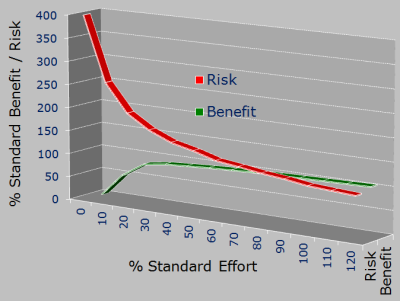
The effort you put in can be balanced against the benefit you
expect and the level of risk you are willing to accept. You would
probably put much more effort into defining, building and testing
an algorithm to calculate the fuel required for a manned mission
to Mars than you would for the fuel required to drive to the next
city and back.
Suppose you could deliver 80% of the overall benefit for only
20% of the effort - but with twice the risk of failure. Would
your client organisation accept that? This is a particularly
important consideration with eProjects where the imperative is to
deliver rapid benefits. It is common to address the 80% of normal
customer needs that can be met in a simple manner and ignore the
20% of difficult situations that would take much more effort.
Often, you might ignore non-standard orders, error handling,
cancellations, etc and leave those processes for manual
intervention.
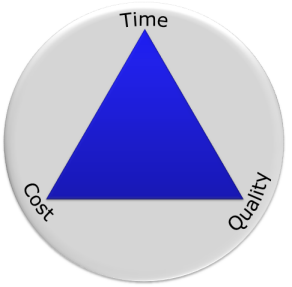 The Project Management Triangle is a very common observation about planning. You will find
several other names for the concept, eg Time/Cost/Quality triangle. It states that if you
adjust the time something takes, or the amount of cost it consumes, or the quality that is to
be achieved, then you will inevitably affect at least one of the other aspects - eg if you want
higher quality it will cost more or take longer to do.
The Project Management Triangle is a very common observation about planning. You will find
several other names for the concept, eg Time/Cost/Quality triangle. It states that if you
adjust the time something takes, or the amount of cost it consumes, or the quality that is to
be achieved, then you will inevitably affect at least one of the other aspects - eg if you want
higher quality it will cost more or take longer to do.
 Although that principle is very useful to keep in mind, the full picture is more complex.
Many methodologists have added further variables to the balancing forces. So, the Project
Management Triangle will be seen with 3, 4, 5 , 6 or more competing pressures, which you will
need to balance to obtain optimum benefit from your project.
Although that principle is very useful to keep in mind, the full picture is more complex.
Many methodologists have added further variables to the balancing forces. So, the Project
Management Triangle will be seen with 3, 4, 5 , 6 or more competing pressures, which you will
need to balance to obtain optimum benefit from your project.
This is the point in the planning process when people often discover they can't afford the cost,
time or resources for the scope they asked for. Usually the best response is to re-examine and
simplify the scope. It is easy to dream of building a mansion when all you really need is a house.
A common response to the competing pressures is "time boxing". Instead of looking at how much time and resource
is required to meet the requested scope, we apply the Time/Cost/Quality triangle principles and consider how much
scope can be achieved within the time, resource and funding we have available. Estimation is still
essential, but the equations are reversed to calculate what we can deliver from the resource we have available.
Time Boxing might be used to re-appraise the optimum scope for the overall project, or it might be applied to set
iterative steps or "sprint" stages in an agile approach.
There are many other factors that will influence the effort it
takes to deliver a successful business solution. Here are many of them:
People
|
Process
|
Technology
|
- Strength of sponsorship
- Availability of good resources for the project
team
- Organisational resistance to change
- Organisational complexity
- Organisational culture
- Morale
- Local cultures
- Ease of communication
- Number of locations involved
- Number of departments to be restructured
- Number of staff affected
- Amount of re-training required
- Impact on external people or bodies (eg
customers, suppliers, regulators)
|
- Number and complexity of processes to be re-engineered
- Extent to which processes are intertwined
- Extent to which the process is within the control
of the Project Sponsor (eg dependence on action
from external supplier)
- Degree of improvement required (eg 10% faster is
easy; 90% faster will be more of a challenge)
- Quality of support for these processes from
commercially available software products
- Availability of best practice knowledge
concerning the processes within this industry
|
- Functionality of IT system
- Complexity of the technology to be used
- Development techniques and languages to be used
- Use of packaged software or component based
technology
- Amount and complexity of integration and
interfacing with legacy systems
- Familiarity of development staff with the
technology to be used
- Productivity of development staff
- Desired quality of solution
- Acceptable risk levels - eg depth of testing
required
- Level of documentation required
|
 But, one final thought. You will often benefit greatly or suffer badly
from human factors. Hopefully, all team members will be competent at their jobs. Some
people turn out to be remarkably skilful and fast at their work. It is particularly
the case with computer programming or configuration. Some people will know everything
about their speciality and instantly see how to create the output with a high degree of
accuracy. Such a person could be ten times faster than normal.
But, one final thought. You will often benefit greatly or suffer badly
from human factors. Hopefully, all team members will be competent at their jobs. Some
people turn out to be remarkably skilful and fast at their work. It is particularly
the case with computer programming or configuration. Some people will know everything
about their speciality and instantly see how to create the output with a high degree of
accuracy. Such a person could be ten times faster than normal.
Occasionally, however, you may find team members who struggle with the challenges and
deliver poor results, far slower than expected.
As well as allowing for such variances in your estimating, watch out for the risk
of basing your estimates on how long a comparable previous project team took to do
something similar. They may have been flying or crawling in comparison.
 A subsidiary technique. Once you have
established a good overall estimate for the project, you
sub-divide it down through the layers of the work
breakdown structure, for example, development will be 50%
of the total, testing will be 25% etc; then sub-divide
development and testing into their components etc etc etc.
A subsidiary technique. Once you have
established a good overall estimate for the project, you
sub-divide it down through the layers of the work
breakdown structure, for example, development will be 50%
of the total, testing will be 25% etc; then sub-divide
development and testing into their components etc etc etc.